Nuisance wildlife
Wildlife Removal in the Salt Lake Valley
Salt Lake City is a wildland-urban interface city. Neighborhoods run right up against the Wasatch foothills and the canyon mouths, and the Jordan River corridor threads green space through the middle of the valley. That is wonderful, and it also means raccoons in the attic, skunks under the deck, and squirrels chewing into a soffit.
Wildlife work is a different discipline from insect control. It involves state regulations, humane handling, structural repair, and biohazard cleanup — and most general pest companies subcontract or decline it.
- Typical cost
- $300–$700 for removal; $500–$3,000 for exclusion and repair; more with attic remediation
- Peak season
- Spring denning (March–June) and fall shelter-seeking (September–November)
- Regulation
- Utah Division of Wildlife Resources governs handling and relocation of protected species
Signs to look for
- —Heavy thumping or scratching in the attic at dawn or dusk
- —Skunk odor concentrated under a deck, shed, or porch
- —Chewed soffit corners, lifted roof edge shingles, or torn gable vent screen
- —Droppings or urine staining on attic insulation
- —Surface runways and dead patches in the lawn after snowmelt (voles)
Who is actually in your attic
Timing tells you a lot. Heavy, deliberate movement at dusk usually means raccoon. Fast scampering in daylight hours is squirrel. Rapid light scratching after dark that starts in October is usually mice or rats rather than wildlife. Fluttering at dusk near a gable end suggests bats.
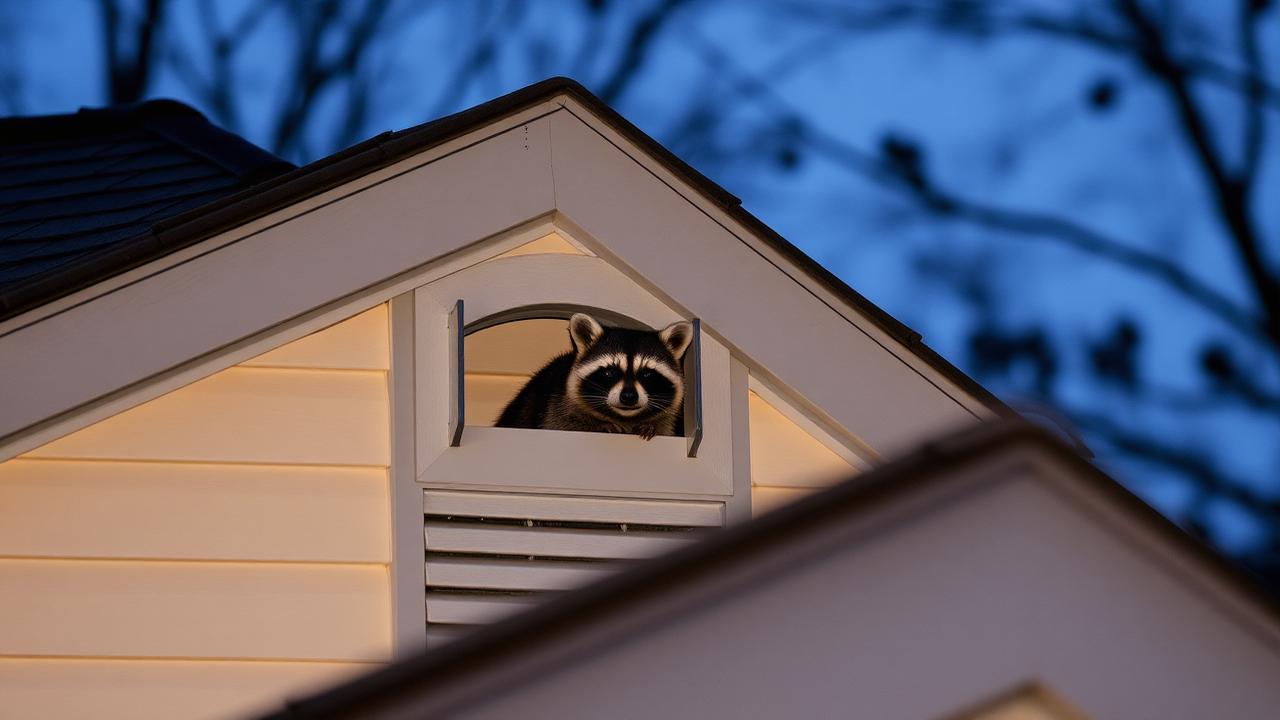
Raccoons enter through roof edges, gable vents, and chimneys, and females in spring are looking for a safe place to raise kits. Rock squirrels and fox squirrels chew soffits and vent screens. Skunks and striped skunks den under decks, sheds, and concrete porches through gaps at grade.
Voles are an outdoor-only problem: they tunnel under the snow all winter and reveal surface runways and girdled young trees in March.
Never seal an entry with young inside
The most common mistake in wildlife work is sealing a hole in spring while a litter is still in the attic. The mother tears a new hole to get back in — often causing worse damage — and any young left behind die in the cavity.
Correct spring practice is to locate the nest, remove the young by hand, and use a one-way door so the mother exits and cannot return, or reunite the family outside the structure. Only after activity has stopped is the entry sealed.
This is also why timing matters for pricing: a spring raccoon job with kits is more labor than the same job in November.
Bats are protected, and the timing window is narrow
Utah's bat species are protected, and several are species of concern. They eat enormous quantities of insects, and they cannot legally be exterminated. Exclusion is the only appropriate approach.
Exclusion must be done outside the maternity season, generally avoiding roughly June through mid-August when flightless pups are present. Sealing during that window traps pups inside the structure.
Do not handle a bat with bare hands. Utah does have rabies in bat populations, and any direct contact — especially a bat found in a bedroom with a sleeping person or a child — warrants a call to the health department.
Exclusion and cleanup are the real work
Removing an animal without sealing the building guarantees a repeat. Exclusion means heavy-gauge steel screening on gable and soffit vents, chimney caps, sealed roof-line junctions, reinforced soffit corners, and buried L-shaped hardware cloth aprons around deck and shed skirting.
Then the contamination: raccoon latrines can contain roundworm eggs, bat guano accumulations pose a histoplasmosis risk, and soaked insulation holds odor that draws the next animal in. Serious jobs include removing contaminated insulation, sanitizing, and re-insulating.
What Utah law allows
The Utah Division of Wildlife Resources regulates the handling of protected species, and relocation is restricted — moving a raccoon across the valley is generally not legal and typically just relocates the problem or kills the animal.
Some species can be handled by a homeowner, others require a licensed nuisance wildlife operator, and some situations should be reported to the state rather than handled privately. When in doubt, call the DWR's regional office before setting a trap.
Common questions
Do pest control companies handle wildlife?
Some do, many do not. Wildlife removal requires different equipment, permitting knowledge, and construction skills for exclusion, so it is often a specialized company or a subcontractor.
What do I do about a bat in the house?
Do not touch it. Confine it to one room, open an exterior window, and let it leave if no contact occurred. If there was contact — or if it was found near a sleeping person or child — contact the health department about rabies evaluation.
How do I stop voles from destroying the lawn?
Keep grass short into late fall, remove heavy ground cover and mulch near trunks, use trunk guards on young trees, and avoid deep mulch against structures. Snow cover over long grass is what lets vole populations expand unseen.
Service details by area
Related guides
More reading
Disclaimer
This site is a free service to assist homeowners in connecting with local service providers. All contractors/providers are independent and SLCPestControl.com does not warrant or guarantee any work performed. It is the responsibility of the homeowner to verify that the hired contractor furnishes the necessary license and insurance required for the work being performed. All persons depicted in a photo or video are actors or models and not contractors listed on this site.